Screenwriting

The pdf version of this page is comprehensive and also includes captures of all the referenced pages.
We were lucky enough to have Owen Black introduce us to the methods and processes of screenwriting. You can read about Owen Black here: Owen Black’s Court Theatre Profile and Owen Black’s NZ On Screen Profile.
What we learned was such a different form of writing from what we’re used to using. I feel it will open up quite a few new ways of looking at things. With screenwriting, the prose golden rule of “show, don’t tell.” goes out the window. Because a screenplay is the blueprint for the production of something else, it needs to be explicit in describing what the audience will see, and provide guidance for the myriad of production team leads who will comb through it looking for what they need to build, have on hand, price out, hire, transport, direct … The screenplay is used to develop the daily Call Sheet which is issued to the cast and crew of a film production to inform them of where and when they should report for a particular day of filming.
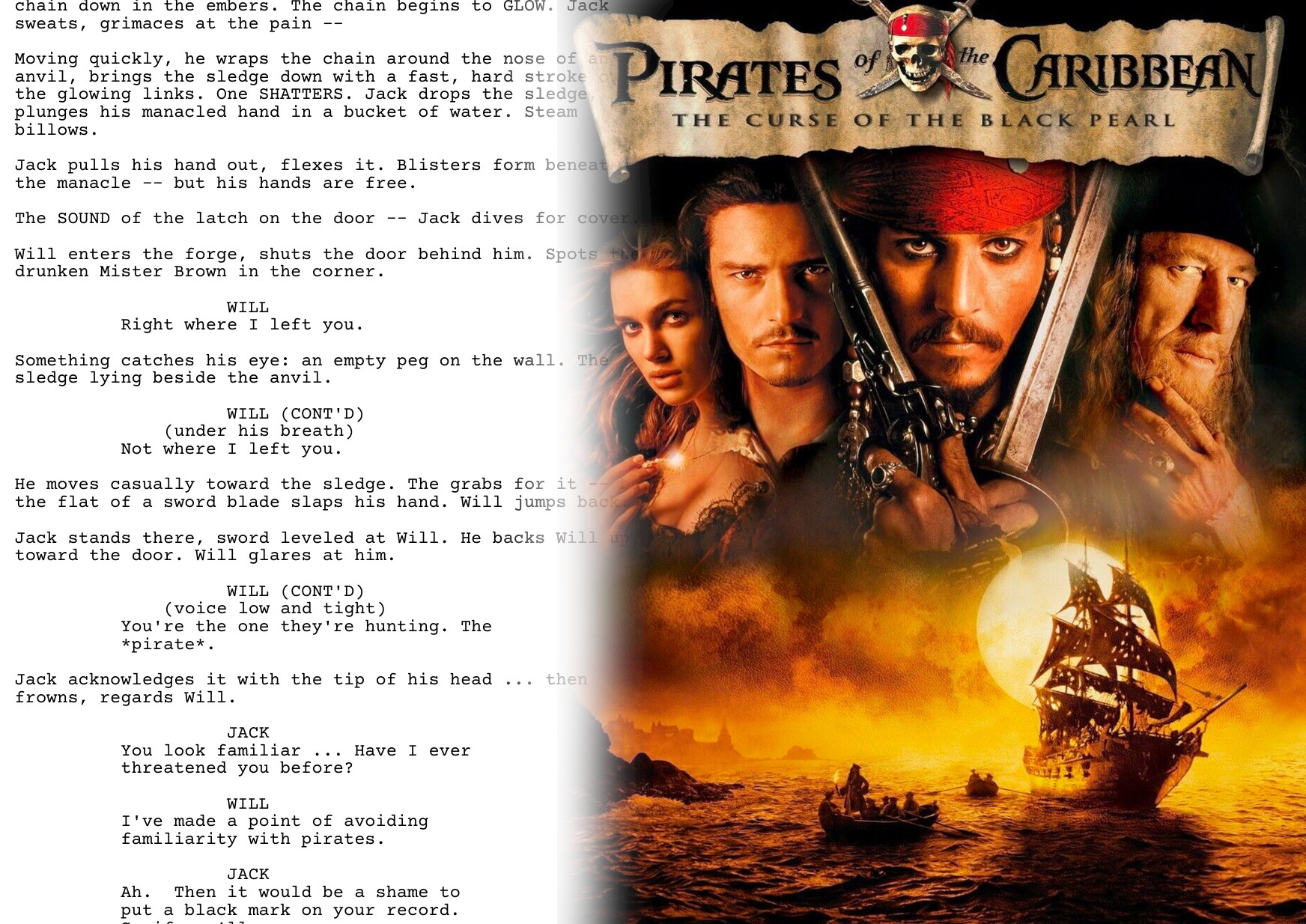
After the session, I will admit I spent a fun few hours last night looking up scripts and then seeing how they compared with the starting scenes of their movies – and maybe watching a bit more than just the starting scene …, to get the flavour of the movie … you know … A good one was Pirates of the Caribbean – Curse of the Black Pearl where the writing is very exacting but there are one or two places where they have come up with a slight modification which worked well. It was interesting to see where there were places in the script where they were intending to give the audience an impression, but it didn’t quite come across that way (at least to me). The example is near the beginning when WILL TURNER gives Governor SWANN the sword that will be presented to the soon to be Commodore NORRINGTON. SWANN says to pass on his complements to WILL’s master. In the script it says;
“Will’s face falls. Clearly, the work is his, and he is proud of it. With practiced ease, he flips the sword around, catches it by the hilt and returns it to the case.”
I wouldn’t have picked that Will had made it, from Orlando Bloom’s face falling, or the slightly forced smile he gives.
A good place to find scripts is: Scriptslug. For the Pirates of the Caribbean – Curse of the Black Pearl for example, go to Scriptslug’s Pirates of the Caribbean page, and click on the Read button.
Screenplay Structure
One one of the biggest surprises for me was learning how structured screenplays are. I had not realised that they needed to be so exacting. But seeing as they need to be read by multiple people with all sorts of different roles, as well as those producing the movie, it makes sense to have a standard format which they can efficiently work through to identify what, and who is needed when.
Once I starting doing my homework, converting a story of mine to a screenplay, I quickly realised that I needed a good guide to the industry standard format. If found some excellent guides on the web.
Studio Binder Article “How to Write a Movie Script”
and
Studio Binder Article “Screenplay Format Mastery”
I have captured the content of these two pages as pdfs here.
Incidentally, Studio Binder is software to correctly format screenplays, thereby leaving the writer to concentrate on that creative process. This leads me on to software for writing screenplays.
As Owen mentioned, there is Screenwriting Software around which takes care of a lot of the formatting rules of sceenwriting and keeps track of a whole lot of other things, such as scenes, characters, etc and is able to provide reports on all the different elements. The one Owen recommended is FadeIn which can be downloaded here: FadeIn Download Page. You can use it for 30 days hassle free and continue to use it free after that if you can put up with being reminded that there is a paid version.
Having found out that there is such a thing as Screenwriting Software, I had a further look around. There is another which is totally free and opensource called Trelby. You can find it here;
This is the one I have chosen to work with.
There are also a bunch of online ones which don’t appear to charge:
For masochists, there is writing the scripts directly in a markdown format called Fountain.
Find out about the Fountain format here: Fountain How-to
Most Screenwriting Software will read this format. The format can then be processed into a pdf with the correct formatting by programs like Trelby or FadeIn, or by dedicated renderers like Afterword.
Selling your Script
Owen also talked about what is required to sell your script. Other than conforming to the industry standards, Genre is a big factor. This needs to come across in the first page. Genre is about anticipation, a list of conventions and tropes that an audience comes to expect from a particular type of story. If a genre film doesn’t deliver on these conventions, it disengages the potential audience. But, then you also want to avoid cliché. It is easy to see why churn the handle movies come about – er. Shrek 41 – Lost in Space maybe?
A great deal hangs on the first page. For some background reading on the art of creating a screenplay, take a look at this webpage.
Industrial Scripts Article “Screenwriting 101 - Your Ultimate 10-Minute Guide”
I have captured the content of this page as pdfs here.
July Homework
There was mention of homework. What we’re suggesting is that you take one of your own stories, or a story you know very well (scene from a book you’ve read, or dig into a fairy tale. Etc), and convert it to a screen play. For top marks sell your story to one of the big studios and get it made into a feature length movie … or create something brand new and never before seen, if you wish.
My response to this homework was turning The Streets of London into a screenplay. This was a story I wrote back in 2019. You can find the screenplay version here: The Streets of London - Screenplay