Portraying Character in Dialogue

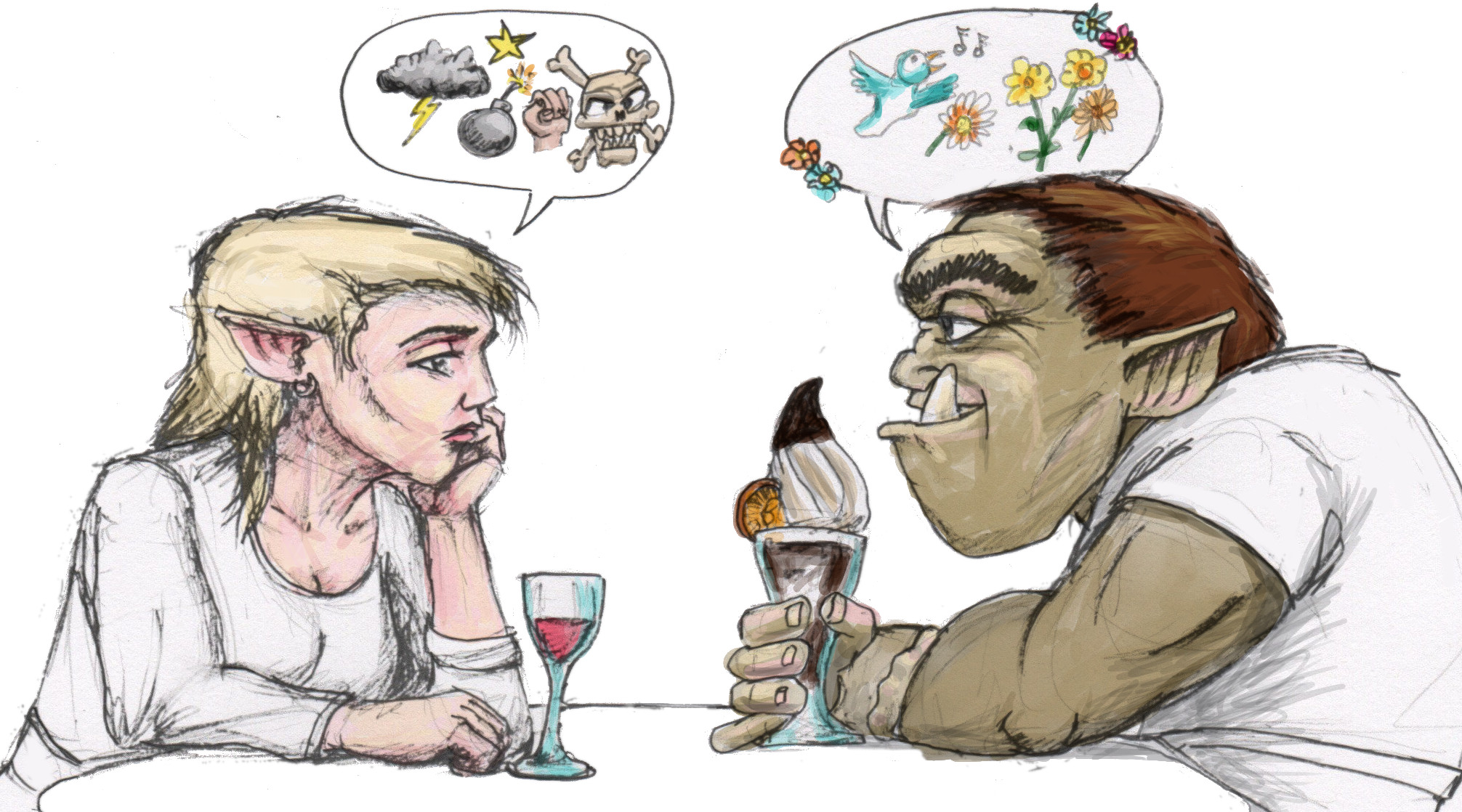
This topic is a great one for making sure we know our characters’ backgrounds, so we can convey their personalities through their dialogue and body language. Whether we’re writing about real people or fictional people, the way they speak and converse is influenced by their upbringing, education, and personality. It will also change depending on the situation, and their state of mind. It is our job to try to capture this in our writing.
Influences on the Way a Person Communicates
Knowing our character’s backstory will help shape the way they talk. If we were writing about real-life people, we would have observed how they communicate and can derive a great deal about them without being told – and we can sometimes get it wrong too.
So it is with our written dialogue – a great deal of the characters’ background can be suggested by the way they communicate, rather than having to tell our audience about them – they will fill in the gaps themselves.
Here is a non-exhaustive exploration of the factors that influence the way someone communicates. Many of these are interconnected, of course.
Upbringing
The environment in which a character grew up will shape their manner of speaking, and may also influence what they value, care about, and how they respond to different situations. For instance, a character that has grown up in a household full of strained relationships, is likely to have a more plain way of speaking than someone who has grown up in a happy and supportive family.
Culture
Someone from a different culture will have a range of slightly different values, and ways of behaving in certain situations.
- There will be topics that they find uncomfortable and so will avoid or skirt around.
- They may know other languages with different structures and ways of pronouncing words – all of which will influence how they use English, and will shape their dialects, and accents.
- They may also use cultural references in their conversations.
Culture can also come from the groups the character hangs around with. Are they in a gang with a very tribal culture, complete with its own initiation rites? Is the character employed in a job where there is a very strong culture of “the boss is right?”
Values and Interests
What a character is interested in or values will influence what they talk about and how they talk about it. For instance, if someone were to ask me about rugby, it would be a very short conversation, but if they were wanting to chat to me about renewable energy or 3D Printing, they may have to come up with excuses to get away.
If the character values other people’s opinions or looks out for their emotions, they will engage in a conversation with another in a very different way to someone who is self-centred or narcissistic.
Personality
A character’s personality will have a huge influence on the way they talk. Do they use humour to cope with tense situations. Are they an extrovert, introvert, ambivert or an otrovert? Are they a monosyllabic sulk, or bubbly friendly positive type. Are they boisterous or reserved? Are they aggressive or timid. Do they lack self esteem, or are they full of bravado? Some personality types will be wordy and expressive, and other will be barely communicative (at least, not in words.)
Education and Self Awareness
The level of education a character has will have some influence of their vocabulary and speech patterns. A highly educated character might use more complex language than a less educated person. Of course education doesn’t need to be formal. In a similar way, a more self-aware character is likely to use more sophisticated language. A way of helping people manage their anger, is by teaching them more words for different emotions. By learning that there are more emotions than just angry and happy, people can unpick why they are angry, and so work out solutions to whatever is causing them to lash out. To me this is a great illustration of how learning about ourselves can create a more sophisticated vocabulary and how the more sophisticated vocabulary can influence our understanding of ourselves and others.
Role
All roles have jargon. What a person does for their role, will influence the type of language they use. If we’re writing about a character in a role that we’re unfamiliar with, we should do a bit of research and learn about the type of terms and jargon they’re likely to be using in their day to day interactions.
In addition to jargon, there will be influences from their position in any hierarchy, and the type of hierarchy they’re working within. Is the hierarchy flat, and accepting of frank, casual language, or is it rigidly structured with a culture of deference and keeping quiet?
Age
People of different ages talk differently to others of their own age, than they do to others older or younger than themselves. There are whole cohorts of people who talk and act differently depending on when they were born. Shared cultural values, and historical events, have helped create age groups who have slightly different mannerisms and values that others. Boomers talk and act differently from Gen Z, for instance.
Related to this is the period in which our characters exist. This is a reflection of the culture at the time. What is acceptable to talk about now may not have been acceptable in upper-class England in 1753. Who knows what cultural changes will happen in the future that will liberate or stigmatise particular topics?
Situation
Situation has a huge influence on how people communicate. If they’re with their mates, they’re likely to be relaxed, casual, and may even drop any cultural affectations they may adopt in the outside environment.
If the situation is stressful or the character is in a high pressure situation, they’re likely to adopt a very efficient communication style which is cut to the bare bones.
If they are a parent talking to a young child, they’re going to use different language to when they talk to their friend – one would hope.
We need to think about how our characters are feeling in the situations we put them in, to help work out how their normal communication patterns will be altered. A lot of this will be down to their personalities. If they are a very self-controlled person, then a stressful situation isn’t going to significantly change their communication style compared to someone who completely goes to pieces every time they need to decide what to have for breakfast.
Ways in Which Personality is Expressed
There are many ways in which a character’s personality, emotions, and values are expressed in dialogue. Here are a number of the main ones.
- Word choice. Does the character use a lot of small words, jargon, colloquial expressions? Do they use contractions such as we’re, it’s and here’s?
- Habitual Phrases. Are there some phrases they use a great deal? You know what I mean?
- Sentence structure. Sentence structure and speech patterns can be distinct for an individual. An extreme example is Yoda. “Size matters not. Look at me. Judge me by my size, do you?”
- Quirks. Does the character never finish a sentence? Do they like say “like” every second or third word, like?
- Delivery. Delivery will be situation-dependent, but our character is likely to have some standard delivery style. Are they aggressive, polite, uncertain, timid, hesitant, arrogant, assertive, or kindly?
- Accent. Everyone has an accent. How you portray this is tricky. Some writers say stay away from portraying accent. Others say, do it in moderation – enough to capture the nature of their accent but not make it unreadable. Accent will be both in the way words are pronounced and in the sentence structure.
- Idioms. An idiom is a saying, or phrase with symbolic rather than literal meaning that is widely recognised and used in everyday language. It can be characteristic of a movement, period, individual, or medium. Here’s some examples: keep tabs on, spill the beans, it’s raining cats and dogs, break a leg.
- Sound and Timbre. In addition to the words, we may want to capture the sound of the character’s voice somewhere in the description. Do they have a deep voice or a nasal whine? Soft-spoken or nails-on-blackboard harsh?
- Body language. Because so much of communication is body language, we can use the occasional description of a character’s body language, to give subtext to what they’re saying. They may be betraying their inner thoughts through their body language. We can suggest this without ever needing to dive into their internal thoughts.
- Responses. How does the character respond to communications with other characters? Are they generally positive, supportive, reactive, or do they flare up? Does the character provide considered opinions or make up something on the spot?
What’s Not Said
A character’s personality can also be portrayed through what they don’t say. Who wants to talk about poo? Well, six year old boys do. Anyone else? Probably not.
We all use euphemisms when talking about certain topics. We want to identify what our characters will skirt around and avoid discussing directly. Topics might include bodily functions, sexuality, or political views. Once we’ve figured out these topics, we can come up with suitable euphemisms for them to use.
Again, body language is useful for portraying any subtext and implying any non-verbal communication that’s going on that may be counter to the actual words the character is saying.
Let Your Character Express Themselves
Unless we’re writing a memoir, the character we’re trying to portray isn’t us. They will have their own emotions, personalities, and drives. We need to let that shine through in their interactions with other characters. We don’t want to hold them back by imposing our own personalities on them. If they’re a complete arsehole, let them be a complete arsehole. We want them to use language which will upset, anger, or make other character’s miserable – that way we can let the reader judge them.
The language we let them use, will help show the type of character they are.
Sources
- “Dialogue Writing Techniques: How to Give Each Character a Unique Voice” – by Lisa Tener
- “Top 14 Tips and Tools for Creating Unique Character Voices” – by K.M. Weiland
- “Creating Distinct Voices: How to Differentiate Your Characters in Dialogue” – by Jen
- “How to Write Characters Who Sound Nothing Like You” – by Jo Light
- “How to Lend Each Character Their Unique Voice (feat. ‘Lord of the Rings’ Dialogue)” – by Alex
- “Writing Dialogue That Rings True to Character Voice Techniques” – by Daniel Redbird
Writing Challenge: Characterisation Through Dialogue
Our writing challenge for this month is to try to capture some communications between characters, that give us a strong idea of their personalities without having to explain it. Take one of the challenges below and write a scene or two.
- Write a conversation between two characters with very different personalities. Focus on making their voices distinct and reflective of their backgrounds, emotional states, ages, etc.
- Take a character of our own, someone from our own memories, a person from history, or make up someone completely new. Now write a scene with them in a relaxed situation having a chat with others. Then write a scene with them in a tense or high stress situation interacting with others. We’ll see if we can capture the different mannerisms and styles in these two very different situations.
- Try writing a short scene which is purely dialogue between two characters, and see how their personalities are expressed in their dialogue. If we can, we’ll try not to use dialogue tags – let their mannerisms and ways of communicating indicate who is talking. Depending on the nature of the scene we may need to include body language descriptions to portray any sub-text that may be going on.
If you are scratching for a prompt, try forming a scene around some characters trying to organise something or coordinate an activity. Use any genre you like. Below are some suggested events that may be happening at the time. Choose one:
- A doctor’s appointment
- An official opening
- Someone splutters with indignation
- Someone gets all nostalgic
- Someone is determined to sing Christmas carols
- Someone denies being in a relationship
- A writing challenge is issued